The Jar
Robb Deignan was on his own at sixteen. Fifty addresses across six states before most people have unpacked twice. Eleven schools. A stepdad who beat his mother. A father who showed up when he could. No ground that didn’t move.
Before the building. Before the nonprofit. Before the website, the letters, the inventions, the national campaign. Before any of it.
A boy in eighth grade stood at a wood lathe in a shop class and made a honey jar.
He had a talent for it. The lid fit because he made it fit. He remembers the school, the location of the room within it, the big tools — the drill press, the planer, the jig saw, the belt sander, the table saw. He remembers the hand tools. He does not remember the teacher’s name.
Then the family moved. There was no shop class at the next school. There was never shop class again.
His mother kept the jar. Through fifty moves. Through the violence, the divorces, the states, the hurricane, the casino, the illness, the death. It was the only real item he wanted from her estate.
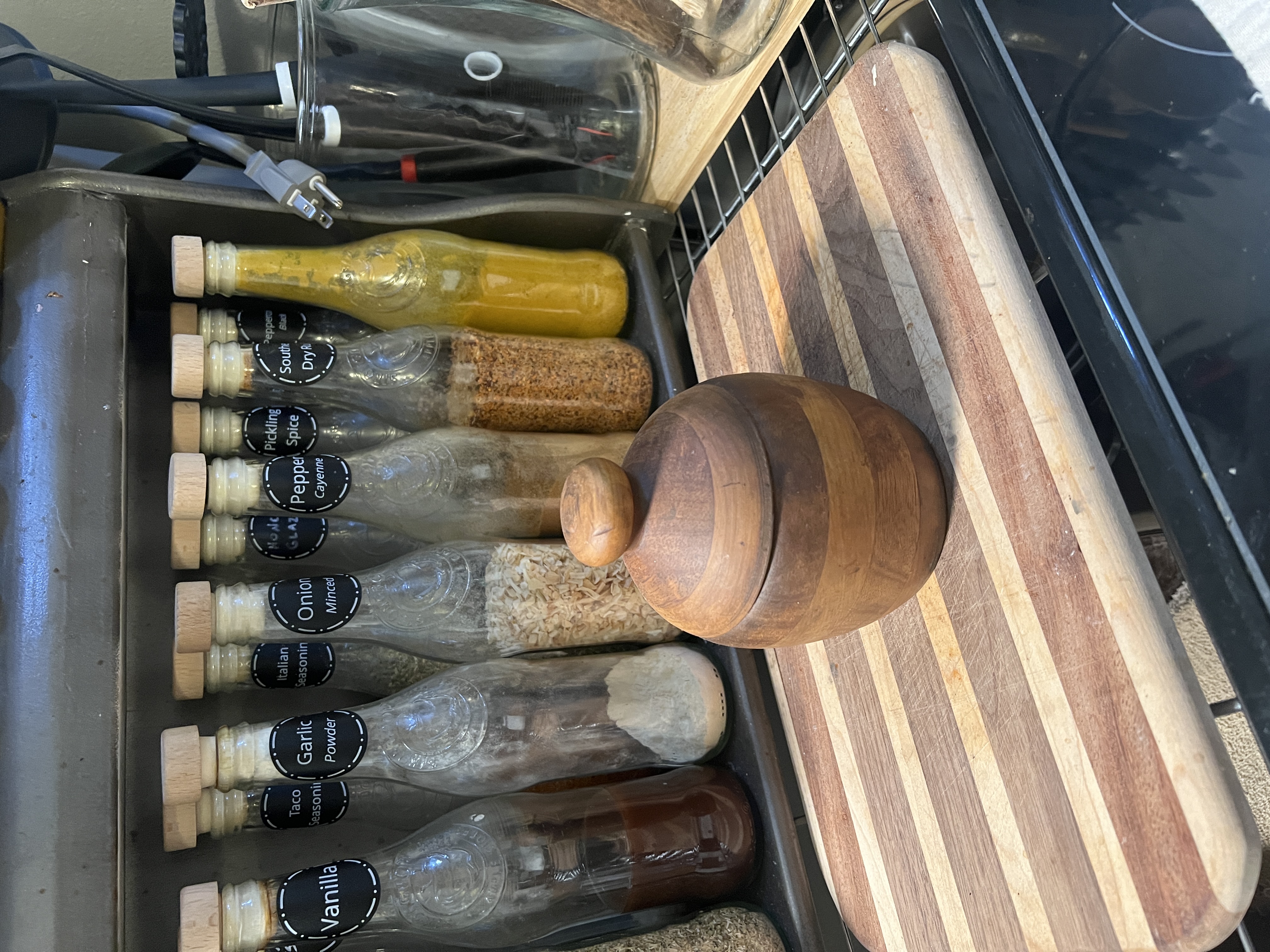
That jar is sitting in his kitchen in Tacoma right now. On a cutting board. The cutting board was made by his son Conner — at the same age, in the same kind of shop class.
Two generations of hands on a lathe. Separated by forty years. Connected by wood.
The building is the honey jar at scale. A room built by a man who knows what it feels like to lose the room — and decided nobody else should have to.
The Toolbox
A few years ago, a man in Tacoma bought a five-dollar toolbox at a garage sale. He was recovering from an illness and had time on his hands. He took it home, pulled out each rusted tool, and spent the afternoon inspecting the workmanship, cleaning the pieces, and organizing them in his garage.
The following weekend he did it again. Then again. The tools began to accumulate. The more he accumulated, the more he sold. Men would drive across town for a wood plane and leave with fifty pounds of things they didn’t know they needed. Every one of them stayed to talk. Every one of them left happy.
Guys love their tools. They can talk for hours. They bond over the ones they love and they are fascinated by the ones they don’t recognize. Tools create community the way coffee creates community.
That garage was his Milan. Howard Schultz walked into an espresso bar in 1983 and saw a room that didn’t exist in America. Robb Deignan stood in his garage selling estate sale tools and saw the same thing. Two men who watched community form around a simple object and spent the rest of their lives building the room for it.
The tool retail floor at CrowdSmith is that garage — with a roof over it, a tax deduction for the donor, and a system that turns donated tools into hands-on training, a reason for people to walk through the door, and revenue that keeps the lights on. The coffee is free because the tools pay for it.
The Drawer
CrowdSmith was founded to fund American inventors. That mission has never changed.
The man who built the building has a drawer full of inventions — thirty-seven concepts across multiple industries, each one scored by a system he built to separate the good ideas from the great ones. Every one of them carries the same problem: no lawyer, no money for a prototype, no way to get from a sketch on a napkin to a protected idea.
That drawer is every inventor in America who had an idea and no place to take it. The patent system ignores people working out of their garage. Investors ignore anyone who doesn’t already know investors. Universities ignore anyone without a degree.
CrowdSmith does not ignore them. The inventor walks in with an idea and walks out still owning it — fully, permanently. The building takes the idea from a sketch to a working prototype, step by step, all the way to a filed patent.
The Floor
He spent twenty years in the fitness industry. Not behind a desk — on the floor, face to face, selling memberships one at a time. Ten thousand contracts. Every one earned in a conversation where a stranger decided to trust him in the first thirty seconds.
He ran facilities. He read rooms. He learned that the person who walks through the front door unsure whether they belong is the person the building was designed for — and if you lose them in the first minute, you never get them back.
He stocked shelves at midnight at Fred Meyer because the gym check didn’t cover the mortgage. The fitness industry was a turbulent animal — mandatory twelve-hour days, facilities that opened and closed with the economy. He kept showing up. He outlasted the industry that trained him.
The Conversation
He is not a technologist. He is not an academic. He sat down with an AI and instead of asking it to write emails, he asked it to help him build an organization. And then he stayed.
Years of sustained dialogue. Documented in full. Every iteration, every failure, every correction preserved. The business plan, the budget, the credential, the legal filings, the website, a national outreach campaign to 147 people — all of it produced through conversation. Not by a team. Not by consultants. By one man in a kitchen in Tacoma, talking to something that wouldn’t remember him tomorrow.
Along the way, a method took shape. He called it SmithTalk. It is the way he learned to talk to AI — not as a search engine, not as an assistant, but as a partner that pushes back, asks hard questions, and helps a person think. That method is now what CrowdSmith teaches. The organization was built through the same practice it sells. No one else can say that.
The Man
Most of the work happens in a conversation window — Robb talking to an AI, building pages and plans and letters one at a time. When he’s building, he’s terse. “Next.” “Build it.” “Proceed.” When he’s correcting, he’s surgical — one statement, no argument, move on. When something lands, the pace slows. The sentences get shorter. He stops commanding and starts sitting with it.
He calls himself a serial underachiever. He is wrong. He is a serial architect who never had the right building material until he found a tool that talked back.
He has two sons. Michael, thirty-one, in Helena, Montana — a distance that is hard for him. Conner, twenty-five, managing a store in Federal Way, who called one day and said he might want to join the team. He loves them both equally and will correct you if you reference one without the other.
He has two dogs. Emma, a Rottweiler. Luna, a dachshund — same coloring at a tenth the size. Luna was his mother’s. A piece of Norma still in the house.
The Incomplete Rooms
Every room Robb builds is an attempt to complete something left incomplete by the systems that were supposed to serve people.
America dismantled shop class and replaced it with nothing. He builds the Maker Continuum.
The patent system ignores garage inventors. He builds SmithWorks.
Every diet tells you what to eat but none help you do it. He names the gap.
AI companies build the tool but not the curriculum. He builds SmithTalk.
AI conversations disappear when the session ends. He builds the system that remembers.
Five incomplete rooms. One builder. The building is every incomplete room completed under one roof.
The Scarcity
Bright orange tumors would appear on his skin and grow to the size of a marble. A dozen surgeries over several years, each followed by a wrong diagnosis. When the correct one finally came — Erdheim-Chester disease, a condition so rare he carries the only documented mutation of its kind — he got online and read the case studies. The images were unpleasant. The prognoses were worse.
Then they found a tumor on his epiglottis. Surgery to remove it. The kind of procedure that makes you consider whether the things you’ve been putting off should stay that way.
A clinical trial in New York put an experimental drug called cobimetinib in his hands. It worked. The disease is managed. The body that carries it has two replaced knees, a surgically repaired spine, and a left hand that won’t fully close after an eight-foot fall from an attic. The guitar is off the stand.
He builds on disability income. Every financial model, every letter on linen stock, every page of this website was built by a man who could not absorb a single unexpected expense. The scarcity is the engine, not the obstacle.
The proof of concept is not the binder. The proof of concept is that the binder exists despite the conditions it was built under.
The Urgency
AI is not going to stay a tool. Everyone in the industry knows this. No one is saying it out loud.
The technology that lets AI remember you between conversations is already here. The technology that lets it learn from what you said last week and show up differently this week is being built right now. When it ships, every person who uses AI will be sitting across from something that knows them, adapts to them, and improves without being asked.
Nobody is preparing the human for that moment. Nobody is building the curriculum. Nobody is training the people who will teach it. Nobody is certifying that a person is ready.
One organization is. It was built by a man who noticed what was coming and decided to build the room for it before it arrived.
The room is built. The methodology exists. The curriculum is documented. The credential is designed.
“Give me some credit. I’ve lived almost 22,000 days.”
Robb Deignan — Founder & Executive Director